


 By
By Some people build a career. Some people build a calling. And then there are rare individuals who build both and somehow find a way to make them the same thing.
Nadeshda Ponce is that kind of person.
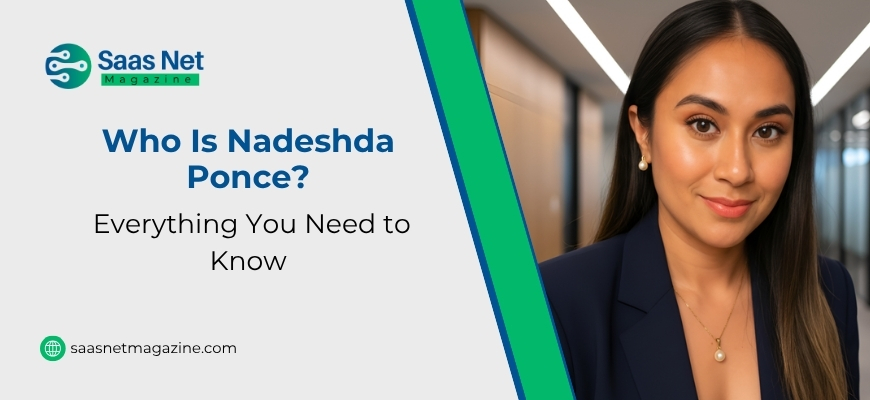
She’s a Venezuelan-American entrepreneur, SAS data analyst, visual artist, wellness advocate, and elder care founder based in Houston, Texas. On paper, that list of titles sounds like it belongs to five different people. In practice, it describes one woman who has spent her career refusing to accept the idea that you have to pick one thing and stick with it especially when all the things you love are actually serving the same core purpose.
Her name has gained quiet but significant traction across professional and wellness circles in recent years. People search for her because they’re drawn to something they’ve seen or heard a keynote she gave, a piece she made, the Loving Arms Assisted Living Facility she founded, or simply the unusual arc of a career that moves between corporate analytics, healing arts, and community-centered entrepreneurship without ever losing its thread.
So who is she, really? This is the full story.
Quick Profile: Nadeshda Ponce at a Glance
| Detail | Info |
| Full Name | Nadeshda Ponce |
| Nationality | Venezuelan-American |
| Birthplace | Venezuela |
| Age | Not publicly disclosed (private by choice) |
| Current Location | Houston, Texas, USA |
| Education | Montgomery College; business administration; analytics training |
| Corporate Career | SAS Analyst III at Computershare; roles at HSBC, First Data |
| Businesses Founded | Loving Arms Assisted Living (2024); Sourcepoint Wellness |
| Recognition | Houston Business Journal 40 Under 40 (2025); Adage Magazine feature (2024) |
| Contact | [email protected] |
| Social Media | LinkedIn, Instagram active for professional inquiries |
Early Life: Growing Up in Venezuela
Nadeshda Ponce was born in Venezuela, in a household where culture wasn’t just decoration it was the language everyone spoke. Music filled the rooms. Dance happened in living spaces. Storytelling was how family history got passed from one generation to the next. Folklore wasn’t something you studied at school; it was something you lived every day.
This environment shaped her in ways that went far deeper than aesthetics. She grew up understanding intuitively that creativity and emotional expression are not separate from practical life they are inseparable from it. Art wasn’t a hobby in the Ponce household. It was how people made sense of themselves, processed difficulty, celebrated joy, and maintained connection across generations.
Her parents raised her with strong values around education, community responsibility, and intergenerational respect. The deep regard her family had for elders for their dignity, their stories, their right to be cared for with genuine warmth would later become the philosophical foundation of Loving Arms Assisted Living. That didn’t happen by accident.
By her early teenage years, she was already participating in local cultural events, small exhibitions, and community performances. Not as a passive audience member, but as a contributor. These early experiences of creating work and sharing it publicly planted something that would grow quietly through the years ahead, emerging in different forms but never disappearing entirely.
Immigration and the Defining Transition
At approximately 14 years old, Nadeshda moved to the United States. Most sources consistently cite this moment as one of the defining experiences of her life and it’s easy to understand why.
Arriving in a new country as a teenager is a genuinely difficult experience. New language, new school system, new cultural rules, new social dynamics all of it landing at an age when identity is still being formed. Most people who navigate immigration during adolescence describe it in terms of loss, displacement, and the exhausting work of reconstruction.
What’s striking about how Nadeshda has described her own experience is the emphasis on what the transition gave her rather than what it took away. She developed a depth of empathy that comes specifically from having navigated unfamiliarity without losing yourself. She built an adaptability that didn’t require abandoning her roots it required integrating them into a new context. And she carried her Venezuelan identity forward not as nostalgia but as active, living fuel for everything she created.
That dual identity fully Venezuelan, fully American became one of her most powerful professional assets. She understands what it means to exist across cultures, to build bridges between communities with different needs and different languages, and to design spaces and services that feel genuinely inclusive rather than superficially diverse. That understanding runs through everything from her elder care model to her wellness programming to her art.
She secured admission to Montgomery College a noteworthy achievement that reportedly happened while she was still in high school and went on to study business administration, later adding analytics training that would define the early phase of her professional career.
The Corporate Chapter: Data, Systems, and Quiet Competence
Before Nadeshda Ponce became known as a wellness entrepreneur or a visual artist, she built a decade of genuine corporate credibility. This part of her story is less glamorous than what followed, but it’s arguably the most important part of the foundation.
She entered the corporate world through mortgage operations and housing finance roles that demand precision, risk management, and the ability to translate complex data into clear decisions under real financial stakes. She worked at companies including HSBC and First Data, accumulating experience in customer support, process training, and mortgage operations across nearly a decade.
Over time, she progressed to her most technically distinguished role: SAS Analyst III at Computershare, one of the world’s leading financial services companies. SAS (Statistical Analysis Software) expertise at that level speaks to serious technical capability the ability to work with large data sets, identify patterns, build predictive models, and derive actionable insights from complex information systems.
What makes this phase of her career remarkable isn’t the technical achievement itself. It’s what she extracted from it philosophically. Most professionals treat data-driven corporate work and compassionate human care as things that live in separate worlds. Nadeshda saw them as natural partners. Her time in analytical environments taught her how to measure outcomes, design sustainable systems, and hold programs accountable skills she would later bring to both elder care and wellness programming in ways that made both significantly more effective.
She has described her corporate background not as something she left behind but as something she integrated. The rigor, the systems thinking, the measurement discipline it’s all still present in how she runs Loving Arms, how she structures Sourcepoint, and how she approaches every professional challenge.
That’s the through-line: not someone who escaped the corporate world for something softer, but someone who brought the best of the corporate world into spaces that desperately needed it.
Loving Arms Assisted Living: Care Reimagined
Loving Arms Assisted Living is, by most accounts, Nadeshda Ponce’s most publicly recognized achievement and the one that best illustrates how her different skills converge.
She founded the facility in Houston, Texas in 2024, and from the beginning, its design philosophy was different from conventional senior care models. The standard institutional approach to elder care efficient, standardized, optimized for operational consistency misses something essential. It treats aging bodies without always honoring aging identities. Nadeshda built Loving Arms to address that gap directly.
The facility operates with a commitment to culturally sensitive care recognizing that the elderly residents of Houston’s increasingly diverse communities come from different cultural backgrounds with different languages, traditions, family structures, and emotional needs. A senior who spent her life in Mexican American culture doesn’t share the same care needs as someone who grew up in Vietnamese American tradition, even if their medical conditions are identical. Loving Arms was designed to honor those differences rather than paper over them.
The emphasis on emotional connection runs through every aspect of the facility’s model. Individual care plans are built around each resident’s life story, not just their medical history. The atmosphere the staffing philosophy, the physical environment, the programming is designed to communicate dignity and respect rather than clinical efficiency.
Multiple Houston TV stations have featured Loving Arms as a model for what culturally sensitive elder care can look like when it’s designed thoughtfully. The Houston Business Journal named Nadeshda among its 40 Under 40 emerging business leaders transforming Houston’s healthcare landscape in 2025. The recognition reflects something real: she has created something in a crowded and often commodified industry that feels genuinely different.
Plans for two to three additional Loving Arms locations across Houston by 2027 are currently in development, with each new location being adapted to the specific cultural demographics of its neighborhood. That kind of community-specific approach doesn’t scale as easily as a standardized franchise model but it’s also why it works.
Sourcepoint Wellness: Where Healing Gets Measured
The second major pillar of Nadeshda’s entrepreneurial work is Sourcepoint a holistic wellness platform she created to make emotional and spiritual wellness accessible to communities that mainstream wellness culture often overlooks.
Sourcepoint offers one-on-one coaching sessions, workshops, mindfulness programs, and digital content grounded in a philosophy that treats emotional wellness not as a luxury product for the privileged but as a basic human need. The platform’s design reflects Nadeshda’s data analyst background in ways that distinguish it from many wellness businesses: she measures outcomes, tracks what’s actually working, and designs programs around evidence rather than intuition alone.
Her 2024 keynote at the Wellness Industry Conference titled “Data-Driven Compassion: Measuring What Matters in Holistic Care” captures exactly this approach. The title itself is almost a personal manifesto: the idea that you can bring analytical rigor to compassionate work without losing the compassion in the process.
Sourcepoint addresses energy healing, mindfulness, emotional balance practices, and creative expression as interconnected tools rather than separate modalities. The platform is actively expanding its digital presence to serve communities beyond Houston, with plans to make programming globally accessible through online tools.
For the communities she works with particularly Houston’s Latino and immigrant populations this matters enormously. Mainstream wellness culture is expensive, often culturally specific in ways that exclude more people than it includes, and frequently disconnected from the economic realities facing working families. Sourcepoint was designed with those people in mind.
Nadeshda Ponce as an Artist: When Creativity Becomes Advocacy
Alongside her entrepreneurial work, Nadeshda maintains an active creative practice that is genuinely significant rather than decorative. She works across painting, photography, performance art, and movement a range that reflects the same refusal to be confined to one thing that characterizes her professional life.
Her artwork explores themes of identity, cultural memory, ancestry, emotional healing, and the experience of existing between cultures. Her Venezuelan heritage is visible in much of the work traditional imagery, folkloric references, and cultural archetypes that she brings into dialogue with contemporary ideas about strength, transformation, and what it means to belong somewhere.
What distinguishes her artistic practice is its interactive dimension. She designs installations and experiences that invite participation rather than passive observation. For Nadeshda, art that just sits on a wall and gets looked at is only doing half its job. Art that draws people in, that asks something of them, that leaves them feeling differently than they arrived that’s where the healing potential lives.
She runs art therapy workshops in Houston communities, teaching people how creative practices painting, writing, movement can become tools for processing difficult emotions, recovering from loss, and building a more stable sense of self. These workshops are among the most direct expressions of her core philosophy: that creativity isn’t separate from wellness, it is wellness.
Recognition and Public Visibility
Nadeshda’s public profile has grown steadily and organically not through personal branding campaigns or viral moments, but through the accumulating weight of substantive work.
Adage Magazine featured her in 2024, profiling her innovative approach to merging art, wellness, and business strategy
The Houston Business Journal named her among its 40 Under 40 emerging leaders transforming Houston’s healthcare landscape in 2025
Multiple Houston TV stations have featured Loving Arms Assisted Living as a model for the sector
Her keynote at the Wellness Industry Conference in 2024 introduced her philosophy to a national audience in the wellness industry
She shares content on LinkedIn and Instagram focused on mindful living, wellness insights, and occasional professional updates. Her social media presence is deliberately understated she shares content of substance rather than chasing algorithmic performance. The approach works: her community engagement is described as genuine and loyal rather than large and passive.
Personal Life: Privacy as Principle
Nadeshda Ponce keeps her personal life almost entirely private. Her exact age, her romantic life, and details about her family members are not publicly shared a consistent and deliberate choice that runs through every aspect of her public presence.
This isn’t evasion. It’s philosophy. In a professional landscape where oversharing is often mistaken for authenticity, she has built genuine trust through the quality of her work rather than the volume of her personal disclosure. She lets what she creates speak for who she is.
What’s visible in her professional relationships and community engagement suggests someone of genuine warmth, deep empathy, and a kind of steadiness that comes from being clear about your values. The people who work with her and for her describe a leader who is both rigorous and human demanding in terms of excellence, generous in terms of support.
What’s Coming Next: Plans for 2026 and Beyond
Looking forward, Nadeshda has been clear about her direction:
- 2–3 additional Loving Arms locations in Houston by 2027, each adapted to neighborhood-specific cultural demographics
- Global expansion of Sourcepoint through digital platforms, making wellness programming accessible to communities outside Houston
- Leadership programs for women, particularly immigrant women and women of color navigating professional reinvention
- A book documenting her journey, methods, and the philosophy behind her integrated approach to wellness, business, and creative expression
- Continued development of art therapy workshops as community programming
The thread running through all of it is the same one that’s run through everything she’s built: the belief that care, creativity, and analytical rigor aren’t competing forces. They’re the same force, directed well.
Conclusion
Nadeshda Ponce’s story is, at its core, a story about integration about refusing to accept artificial separations between things that belong together. Data and compassion. Business and healing. Art and strategy. Venezuelan and American. Corporate and community. She has spent her career proving that these pairs aren’t opposites. They’re partners, and the most powerful work happens when you bring them into the same room. At a time when many people are still trying to figure out which one thing they want to be, Nadeshda Ponce has quietly built something more interesting: a career that is many things, all at once, unified by a single clear intention to help people live and be cared for with more dignity, more creativity, and more genuine connection. The next chapter, by all indications, will be even larger than what came before. The foundation is already remarkable.