<div class="main_card" >
<span  class="main_card_heading">Quick Intro:</span>
<p  class="paragraph">
There's a frustration most content creators know well. You record a podcast episode, then separately shoot a video version of it, then write a blog summary, then manually post all three across different platforms each with its own upload requirements, aspect ratios, and audience expectations. By the time you're done, hours have disappeared and the creative energy that started the whole process has long since evaporated.</p></div>
<h3 class="heading3">Mobile Dual Media was built to solve exactly that.</h3>
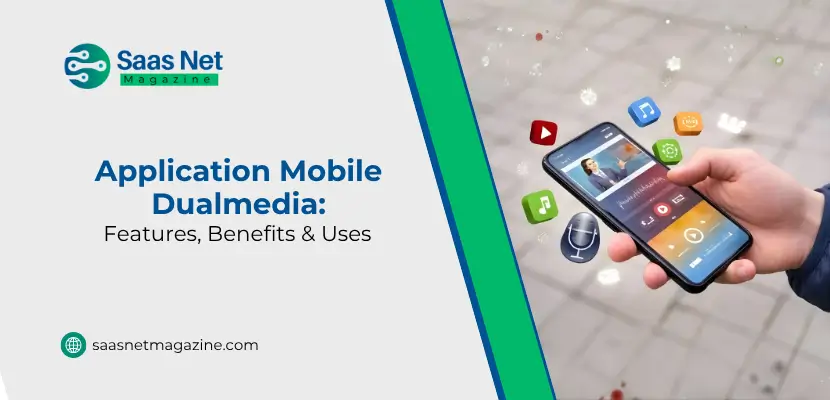
<p  class="paragraph">Not just as a workflow tool, but as a fundamental rethinking of how multimedia content gets created, packaged, and delivered from a single mobile interface. The premise is straightforward: instead of treating audio and video as separate media types that require separate apps and separate production pipelines, Dual Media combines them letting creators produce, broadcast, and monetize both formats simultaneously from one platform.
The concept sounds simple. The implications, once you start working through them, are considerably more interesting.</p>

<h2 class="heading2">What Is Application Mobile Dual Media?</h2>

<p class="paragraph">At its core, Application Mobile Dual Media is a mobile-first multimedia platform that integrates multiple content types primarily audio and video, but often extending to text, interactive elements, and images into a single unified interface.</p>

<p class="paragraph">Unlike traditional platforms that focus solely on video or audio, Dual Media supports dual formats simultaneously, allowing creators to broadcast audio and video together, or even switch between formats live. That live-switching capability alone separates it from most mainstream media apps, which lock you into a single format once you've started.</p>

<p class="paragraph">The platform runs on cloud infrastructure, which removes traditional production limits that often constrain creators. This means you're not working against hardware constraints on your phone the heavy processing happens server-side, and your device just handles the interface and capture.</p>

<p class="paragraph">Think about what that enables in practice. A podcaster who has always avoided video because of the editing overhead can now run audio-first content with an optional video layer that viewers can choose to enable. A language tutor can deliver a lesson in audio format for commuting students while simultaneously offering a visual version with screen-share for those sitting at home. A music producer can release tracks with accompanying visual elements, all managed from one place.</p>

<p class="paragraph">The underlying idea is simple: people consume media differently depending on context, and forcing them into a single format wastes engagement. Dual Media doesn't ask users to adapt to the platform. It adapts to how users actually want to engage.</p>
<h2 class="heading2">Key Features of Application Mobile Dual Media</h2>

<h3 class="heading3">Simultaneous Audio and Video Broadcasting</h3>

<p class="paragraph">The foundational feature. Dual Media lets creators broadcast audio and video together or switch between formats during live sessions, eliminating the need to manage separate workflows for different media types.</p>

<p class="paragraph">This isn't just a convenience feature. For creators running both a YouTube channel and a podcast, the traditional approach means producing essentially the same content twice through two completely different production pipelines. Dual Media collapses those into one session, then handles the format-specific output automatically.</p>

<h3 class="heading3">Cross-Platform Publishing</h3>

<p class="paragraph">With one click, users can simultaneously post their content on YouTube, TikTok, Instagram, Spotify, and other major platforms. Each platform gets the appropriate format video for YouTube, audio for Spotify without requiring separate exports.</p>

<p class="paragraph">This is the feature that tends to convert creators who were skeptical. The time saved on cross-platform publishing alone is substantial for anyone maintaining a presence across more than two channels.</p>

<h3 class="heading3">Cloud-Based Storage and Processing</h3>

<p class="paragraph">Dual Media uses end-to-end encryption to protect all personal data and uploads. Every user gets base cloud storage with upgrade options, and the cloud infrastructure handles transcoding, format conversion, and platform-specific optimization in the background.</p>

<p class="paragraph">The practical benefit: you record once at the highest quality your device supports, and the platform handles the downward conversion for platforms that require lower resolutions or bitrates.</p>

<h3 class="heading3">AI-Assisted Content Management</h3>

<p class="paragraph">From AI captioning to dual-format live switching, the application offers creators time-saving features most users never knew existed. Automatic caption generation across both audio and video formats, smart tagging for discoverability, and AI-powered thumbnail suggestions are all integrated without requiring third-party tools.</p>

<p class="paragraph">When social media feedback comes in, DualMedia automatically updates content in email sequences, blog posts, and advertising copy. That kind of reactive content management adjusting how content is packaged based on how audiences actually engage with it was previously the domain of enterprise marketing teams with dedicated tools and staff. On Dual Media, it's a default feature.</p>

<h3 class="heading3">Monetization Integration</h3>

<p class="paragraph">Integrated features like sponsored content management, pay-per-view, tip jars, and exclusive content paywalls allow creators to earn directly through the app. Revenue generation doesn't require redirecting audiences to external platforms the entire creator economy infrastructure exists inside the application.</p>

<h3 class="heading3">Interactive Media Layers</h3>

<p class="paragraph">Beyond audio and video, the platform supports interactive elements polls, quizzes, clickable segments, and branching content paths that turn passive consumption into active engagement. This is particularly relevant for educational content, where interactivity has measurable effects on retention.</p>
<h2 class="heading2">The Benefits That Actually Matter</h2>

<h3 class="heading3">For Creators: Time Compression</h3>

<p class="paragraph">The most immediate and consistent benefit reported by creators is time. Producing a piece of content once for multiple formats rather than separately for each doesn't just save editing hours. It reduces the cognitive overhead of maintaining parallel production workflows. You make one creative decision and the platform handles the distribution logic.</p>

<p class="paragraph">One tech reviewer grew his YouTube and podcast audiences by 150% in 60 days by consolidating his entire workflow through DualMedia. That growth came not from dramatically increasing output but from reaching audiences that were previously inaccessible because separate format production was too time-consuming.</p>

<h3 class="heading3">For Audiences: Format Flexibility</h3>

<p class="paragraph">Users don't stick to one device. They start watching something on their phone, switch to a tablet, and pick it up again on a laptop. Cross-platform mobile apps that support dual media ensure that the experience stays consistent across all screens. Content syncs in real time. Preferences carry over. Nothing gets lost in transition.</p>

<p class="paragraph">The modern media consumption habit is fundamentally fractured. People start a video on mobile during a commute, switch to desktop for a longer session, and might finish as audio while cooking dinner. Dual Media treats that behavior as normal rather than working against it.</p>

<h3 class="heading3">For Retention: The Dual Sensory Effect</h3>

<p class="paragraph">Studies show users remember 75% more content when it's presented through dual sensory channels such as visual plus auditory input. Combining media types caters to diverse learning styles, increasing session duration by up to 40% according to 2025 industry reports.</p>

<p class="paragraph">This is the science behind why educational content produced in dual formats consistently outperforms single-format material on engagement metrics. Presenting information through both auditory and visual channels simultaneously gives the brain two encoding pathways and that redundancy strengthens retention in ways that single-format content simply can't replicate.</p>

<h3 class="heading3">For Businesses: Unified Analytics</h3>

<p class="paragraph">Instead of pulling engagement data from YouTube, Spotify, Instagram, and a podcast platform and trying to synthesize it manually, Dual Media aggregates performance data across all published formats into a single dashboard. The platform's real-time AI dashboards have shown a remarkable 25% increase in engagement rates, with content feeling personally tailored whether it appears in emails, apps, or programmatic advertisements.</p>

<p class="paragraph">That kind of consolidated insight changes how businesses make content decisions. Instead of optimizing each format in isolation, you can see cross-format performance patterns and allocate creative effort accordingly.</p>
<h2 class="heading2">How Application Mobile Dual Media Works</h2>

<p class="paragraph">The technical foundation is worth understanding, even at a high level, because it explains why the platform is able to do things that traditional media apps can't.</p>

<p class="paragraph">Dual Media apps use mobile content delivery systems that are smarter and faster. Content gets pushed to users based on their preferences, device type, and network conditions. Streaming media integration ensures that video and audio load seamlessly, even on slower connections.</p>

<p class="paragraph">At the creation end, you record through the app using your device's camera and microphone. The application manages simultaneous audio and video capture with independent quality controls for each so you can, for instance, capture high-quality audio while using a compressed video stream to reduce file size.</p>

<p class="paragraph">During a live broadcast, the format-switching technology allows you to move between audio-only and full video modes in real time without interrupting the stream or requiring audience reconnection. The platform detects the switch and transparently adjusts what each viewer or listener receives based on the mode they've chosen.</p>

<p class="paragraph">After production, the cloud processing layer handles transcoding for each distribution platform. The creator doesn't select export settings they select distribution targets, and the platform applies the correct technical specifications automatically.</p>
<h2 class="heading2">Where Dual Media Is Being Used: Industry Applications</h2>

<h3 class="heading3">Education and Online Learning</h3>

<p class="paragraph">Language apps pairing video dialogues with speech-recognition exercises are a prime example. Apps like Byju's or Coursera use video learning plus interactive tests to create a richer, more engaging learning environment.</p>

<p class="paragraph">Educational platforms built on dual media principles are producing measurable improvements in course completion rates and knowledge retention. The ability to layer audio explanation over visual demonstration and to give learners control over which format they prioritize addresses the fundamental problem that traditional video courses can't adapt to different learning preferences.</p>

<p class="paragraph">A language instructor who previously maintained separate podcast episodes for listening practice and YouTube videos for conversation modeling can now deliver both from a single production session, with students choosing the format that suits their current context.</p>

<h3 class="heading3">Healthcare and Wellness</h3>

<p class="paragraph">Therapy apps combining guided meditation audio with biometric feedback visualizations give users a more integrated wellness experience.</p>

<p class="paragraph">Mental health and wellness applications are finding dual media particularly effective because the pairing of audio guidance with visual feedback creates a feedback loop that purely audio-based meditation apps can't provide. When users can see their breathing pattern or heart rate response while following audio guidance, the experience becomes more engaging and the outcomes more measurable.</p>

<p class="paragraph">Healthcare providers are also using dual media platforms for patient education delivering procedure explanations as audio for anxious patients who don't want to watch video, while making visual versions available for those who find visual demonstration more reassuring.</p>

<h3 class="heading3">E-Commerce and Retail</h3>

<p class="paragraph">Virtual try-on features merging AR overlays with product storytelling videos help reduce buyer hesitation and increase purchase confidence.</p>

<p class="paragraph">Retail applications leveraging dual media are seeing meaningful reductions in return rates. When a product demonstration video is paired with interactive features size visualization, material zoom, color switching the purchase decision becomes more informed and the post-purchase satisfaction higher.</p>

<p class="paragraph">Fashion and beauty brands are particularly active in this space, using dual media to deliver both the narrative storytelling of traditional advertising and the practical information of a product review, simultaneously, in the same mobile experience.</p>

<h3 class="heading3">Journalism and News Media</h3>

<p class="paragraph">Articles embedding interactive data visualizations alongside video reports are transforming how news is consumed making it more contextual and compelling.</p>

<p class="paragraph">The traditional news article and the news video have existed as separate content types in separate contexts. Dual media formats allow news organizations to create pieces where the written analysis and the visual reporting coexist and reinforce each other. A reader who wants depth can read; someone wanting context quickly can watch; someone who absorbs information better through audio can listen to the text read aloud.</p>

<h3 class="heading3">Corporate Communications and Training</h3>

<p class="paragraph">Internal communications teams are discovering that dual media formats dramatically improve engagement with training material that employees previously skimmed or ignored entirely. The same compliance training module that had completion rates under 40% in slide format often performs significantly better when delivered as a combination of narrated audio and supporting visual content with interactive checkpoints.</p>
<h2 class="heading2">Challenges and Real Limitations</h2>

<p class="paragraph">Honest coverage of any platform requires acknowledging what doesn't work yet.</p>

<p class="paragraph">Device dependency. Despite the cloud infrastructure, capture quality still depends heavily on the device being used. Budget smartphones produce noticeably inferior audio and video, which can undermine the dual format experience even when the platform itself performs correctly.</p>

<p class="paragraph">Learning curve. The workflow is different enough from single-format tools that creators who are deeply invested in their existing production processes often find the transition disruptive before it becomes efficient. The efficiency gains take time to materialize.</p>

<p class="paragraph">Internet reliability. Cloud-based processing is powerful when connectivity is strong. In lower-bandwidth environments, live dual-format broadcasting can degrade in ways that make it less compelling than simpler alternatives.</p>

<p class="paragraph">Platform compatibility. Not every distribution channel has fully integrated dual media standards. Publishing to some platforms still requires format compromises that reduce the benefit of dual-format production.</p>

<h2 class="heading2">Where This Is Going: Future Trends</h2>

<p class="paragraph">The trajectory is toward deeper AI integration and more seamless format adaptation. As AI caption generation, automatic translation, and smart content summarization improve, the gap between producing one piece of content and reaching multilingual, multiformat global audiences will continue to close.</p>

<p class="paragraph">Spatial audio integration is an emerging area delivering audio that responds to the listener's physical environment or device orientation, layered over video content. AR/VR integration with dual media platforms is also developing, with early applications in virtual events and immersive educational experiences.</p>

<p class="paragraph">The broader pattern is one of progressive format dissolution. The distinction between audio content and video content is becoming less meaningful as audiences increasingly expect to choose their own format rather than accepting the one the creator chose for them. Application Mobile Dual Media is built on exactly that principle and as that expectation spreads, the platforms that support it will have a structural advantage over those that don't.</p>


<div class="card_bottom">
<h3 class="heading3">Conclusion</h3>
<p class="paragraph">The real significance of Application Mobile Dual Media isn't the technology. It's the assumption embedded in that technology that audiences should have control over how they experience content, not just access to it. For most of the internet's history, creators made format decisions and audiences accepted them. That's changing. The platforms that thrive in the next few years will be the ones that treat format flexibility as a baseline requirement rather than a premium feature.
Dual Media didn't create that shift. But it's building the infrastructure that makes it practical one creator workflow at a time.
</p>
</div>

<style>
.main_card{
margin: 20px 0px; padding: 20px; background: #e3f2fd; border-left: 4px solid #d31318; border-radius: 4px; color: #333333; font-family: -apple-system, BlinkMacSystemFont, 'Segoe UI', Roboto, 'Helvetica Neue', Arial, sans-serif; font-size: medium;
}
.main_card_heading{
margin: 0px; padding: 0px; font-weight: 600; color: #005190;
}
.heading2{
margin-top: 7px; margin-bottom: 20px; padding: 0px 0px 0px 15px; font-size: 1.8em; color: #005190; border-left: 4px solid #00b96f; font-family: -apple-system, BlinkMacSystemFont, 'Segoe UI', Roboto, 'Helvetica Neue', Arial, sans-serif;  border-radius:4px;
}
.heading3{
margin-top: 7px; margin-bottom: 20px; padding: 0px 0px 0px 1px; font-size: 1.6em; color: #00b96f;font-family: -apple-system, BlinkMacSystemFont, 'Segoe UI', Roboto, 'Helvetica Neue', Arial, sans-serif;
}
.paragraph{
padding: 0px; text-align: justify; color: black; font-family: -apple-system, BlinkMacSystemFont, 'Segoe UI', Roboto, 'Helvetica Neue', Arial, sans-serif; font-size: medium;
}
.anchor{
color:#d31318;
}
.card_bottom{
margin: 20px 0px 0px; padding: 20px; color: #333333; font-family: -apple-system, BlinkMacSystemFont, 'Segoe UI', Roboto, 'Helvetica Neue', Arial, sans-serif; font-size: medium; background: #e3f2fd; border-radius: 6px; border-left: 4px solid #d31318;
}
.btnbt{
margin: 20px 10px 10px 0px; padding: 12px 24px; display: inline-block; background: #27477d; color: white; border-radius: 4px; font-weight: 600;
}
</style>



 By
By